
A few times a month someone lingers at our front desk after a session and asks a question that has nothing to do with salt. They are building a wellness room at home, or they run a gym or a physio practice and want to add “something with oxygen,” and they have three options open in browser tabs: a salt room, an EWOT bike setup and a hyperbaric chamber. Which one, they ask, would we put in?
We run a salt room, so we have an obvious bias, and we would rather name it than hide it. This entry is our attempt to answer the question the way we would want it answered if we were spending our own money: what each piece of equipment actually does, what it costs to buy and keep running, how much floor it eats, and what the research does and does not say. Including about salt.
Three machines that get lumped together
They show up on the same wellness lists, but the three modalities share almost nothing mechanically.
A salt room (halotherapy) is a normal room at normal pressure. A halogenerator grinds pharmaceutical-grade salt into a fine dry aerosol and blows it into the space while guests sit and breathe for about forty-five minutes. The salt on the walls and floor is mostly atmosphere; the generator is the working part. Nothing about the oxygen in the room changes.

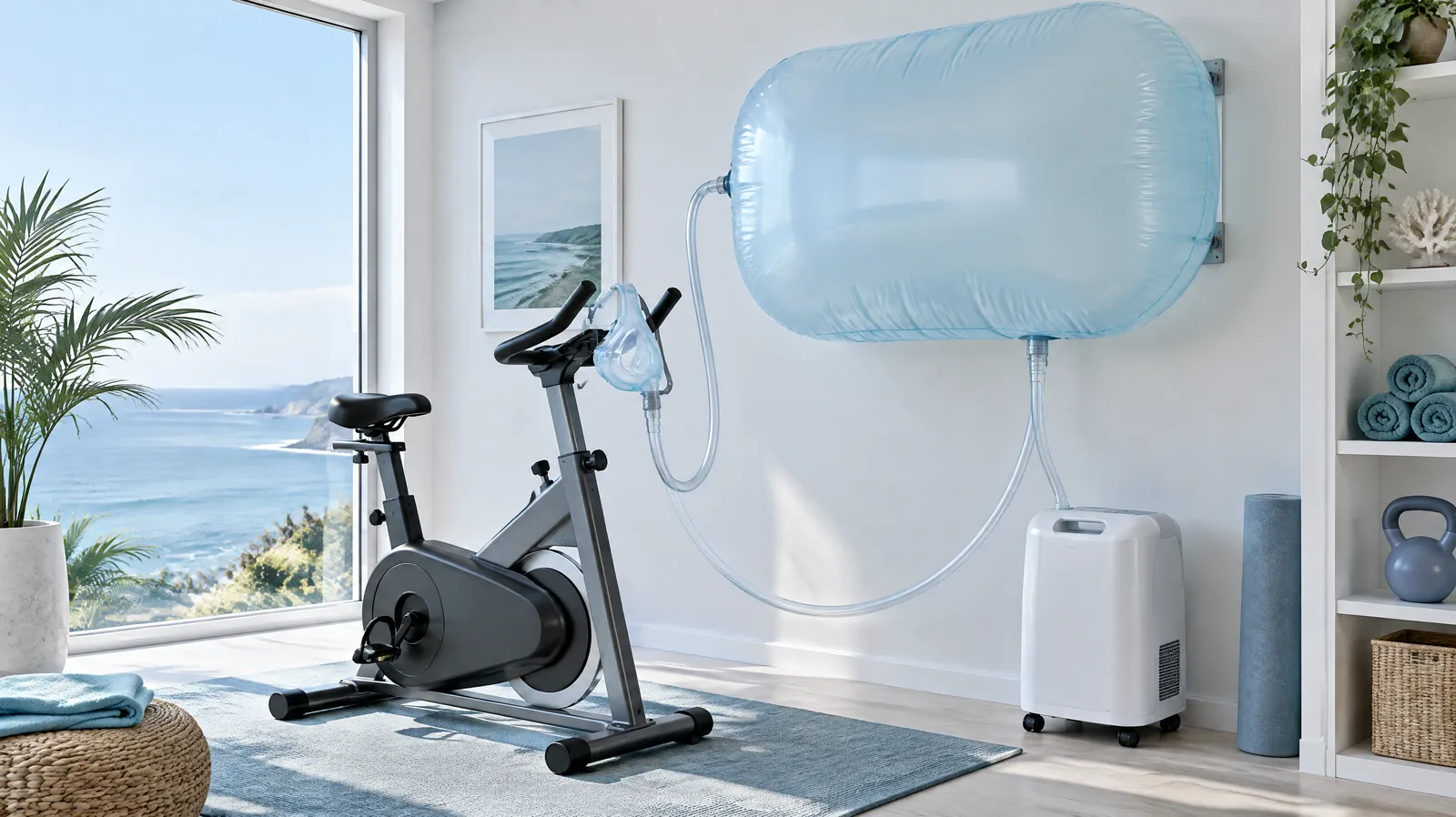
EWOT (exercise with oxygen therapy) pairs a short, hard workout on a bike, rower or treadmill with a mask fed by an oxygen concentrator, often through a large reservoir bag so the user can draw high-concentration oxygen faster than the concentrator alone could supply it. Pressure stays at one atmosphere. Sessions are short, typically around fifteen minutes, and the effect people notice is mostly the effect of the exercise.
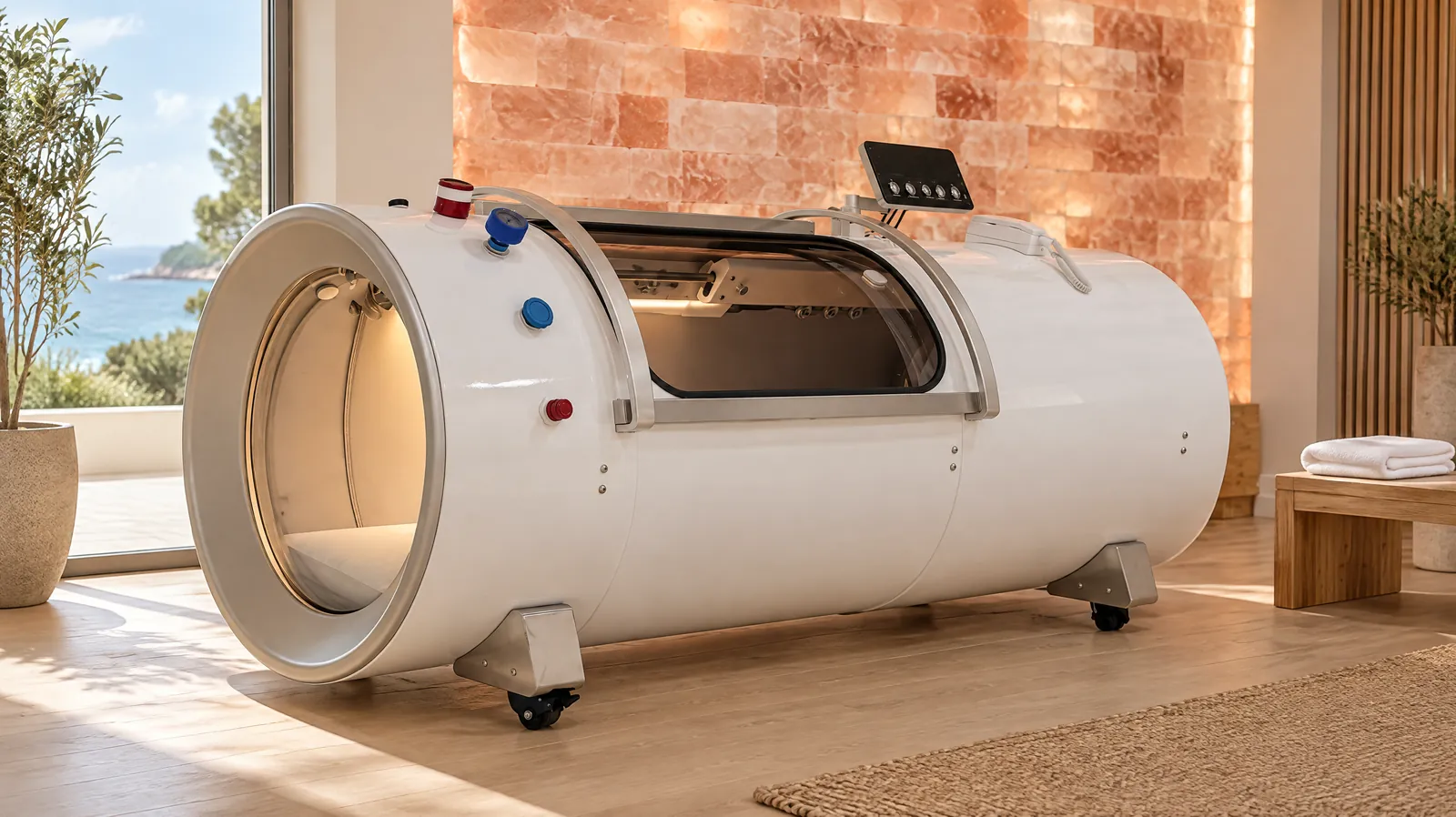
A hyperbaric chamber is a sealed vessel pressurized above normal atmospheric pressure, measured in ATA (atmospheres absolute). Mayo Clinic describes clinical hyperbaric oxygen therapy as breathing pure oxygen at two to three times normal air pressure, with most treatments lasting an hour and a half to two hours. Home and wellness chambers sit lower: soft-shell units typically run at 1.3 to 1.5 ATA, and hard-shell units commonly reach 2.0 ATA. Under pressure, more oxygen dissolves directly into blood plasma, which is the whole reason the category exists.
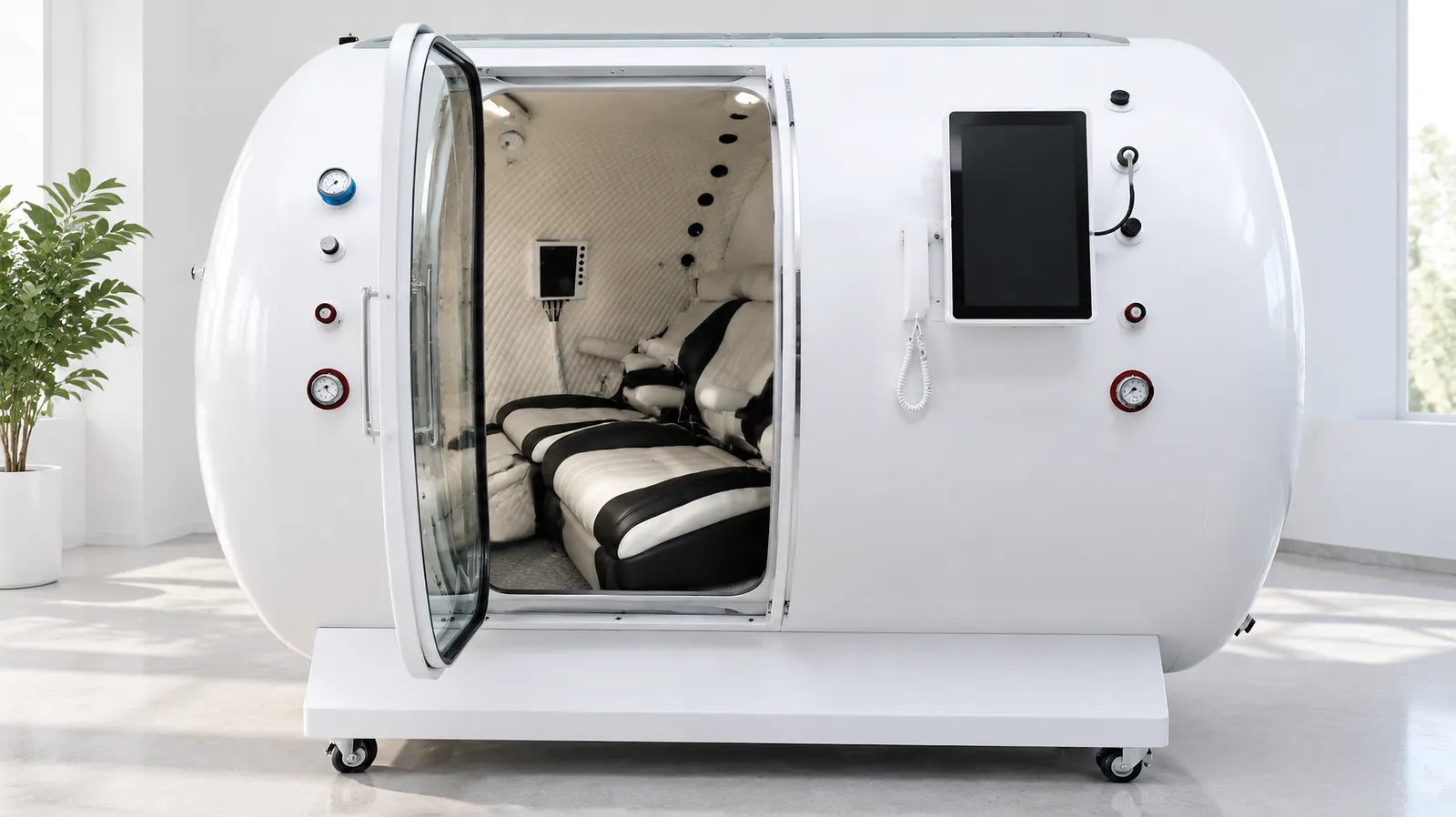
Chambers also come in two layouts. A monoplace chamber holds one person, usually lying down. A multiplace chamber holds two or more, and in the clinical version the whole vessel is pressurized with air while each person breathes oxygen through a mask or hood. Mayo Clinic notes the treatment effect is the same in both. For a studio, the layout matters less for physiology than for bookings, which we come back to below.
Pressure and oxygen, in plain terms
If you remember one distinction, make it this one. A salt room changes what is suspended in the air. EWOT changes the oxygen fraction of what you breathe while your heart and lungs move a lot of it. A hyperbaric chamber changes the pressure, and pressure is the only one of the three variables that pushes substantially more oxygen into plasma rather than onto hemoglobin, which is already close to saturated in a healthy person at rest.
That is also why the popular line that fifteen minutes of EWOT “equals” an hour of hyperbaric time does not hold up. The two can move comparable volumes of oxygen through the lungs, but they do not produce the same oxygen tension in tissue, and no head-to-head trial has shown them to be equivalent. For a readable breakdown of the physiology and the five-year running costs, we would point you to Superhuman Chambers’ EWOT vs HBOT comparison, which lays out the plasma numbers at each pressure level. It is a chamber maker’s page, so read it with that in mind, but the arithmetic is shown.
“Mild” hyperbaric is still a pressurized vessel
Many buyers assume a 1.3 ATA soft chamber is a gentle, unregulated wellness gadget. The specialist bodies disagree. In a 2022 joint position statement, the European Committee for Hyperbaric Medicine and the European Underwater Baromedical Society said that putting someone in a pressurized chamber to breathe gas is a medical procedure regardless of the pressure, the oxygen level or what the shell is made of. They added that the fire risk of enriched oxygen and the barotrauma risk of unplanned pressure changes do not allow anyone to define a “safe” threshold, and that in the EU so-called mild chambers should meet the rules for Class IIb medical devices.
In the US, the FDA treats hyperbaric chambers as Class II medical devices cleared through the 510(k) process, and says cleared devices can be looked up under product code CBF in its 510(k) database. Ask any seller for that clearance before you ask about upholstery colours.
What each one costs to own
Prices move, and we have only listed numbers we could read on a seller’s own page.
- Salt room. Salt Chamber Inc., a US equipment maker, puts halogenerators at $4,995 to $6,500 and salt décor for a room at $17,500 to $27,500, with HVAC changes starting around $200 depending on the building. Saltroom Builders quotes roughly $10,000 for a small residential salt room up to $40,000 for a large high-end commercial one. The consumable is cheap: the same Salt Chamber page says a 10 lb container of generator salt costs $25 and typically lasts several hundred sessions. Plug-in salt booths for one person are the small-footprint alternative; Salt Chamber puts them at around $6,995 for a basic model up to around $15,995 for its most elaborate one.
- EWOT. One Thousand Roads, an EWOT retailer, lists a 5 LPM system at $1,899.99 and a 10 LPM system with a 1,000-litre reservoir at $2,499.99, plus an optional annual maintenance plan at $199.99. The higher flow rate refills the reservoir faster between hard efforts. You still need the exercise machine, and you probably already own one.
- Hyperbaric chamber. This is the step change. As one reference point, Superhuman’s published “from” prices run $14,900 for its 1.5 ATA soft-shell S1, $49,900 for the single-occupant 2.0 ATA L1, $99,900 for the two-seat T2 and $169,000 all-inclusive for the four-person T4. OxyHealth, one of the older names in the field, sells soft chambers such as the Vitaeris 320 and Quamvis 320 at 1.3 ATA alongside a hard-shell line it describes as able to operate from 1.3 to 4.0 ATA. Airvida lists hard-shell lying and seated chambers at 1.5 to 2.0 ATA and a portable lying model at 1.5 ATA. Quotes across makers vary widely with pressure, size and what is bundled (oxygen concentrator, compressor, installation).
On the revenue side, the Salt Therapy Association says salt sessions are usually priced between $15 and $60, depending on the local market and on adult, child and senior rates. The figure that matters more for a studio is that one salt room serves several people per session, while a chamber or an EWOT rig serves one person (or a few, in a multi-seat chamber).
Space, sessions and upkeep
A salt room wants a dedicated room, and it wants it closed: salt aerosol drifts, and it is hard on electronics and bare metal outside the treatment space. A comfortable studio room for four to six recliners is a modest footprint, but the generator usually needs a separate equipment closet behind the wall.
One build mistake we see suggested online: combining a brine graduation tower (a wet, circulating salt-water feature) with a dry-salt halogenerator in the same room. Salt cave builders warn against it, because moisture makes the dry particles clump and settle, and turning the generator up only adds residue. If you want both, give each its own room and its own climate control.
EWOT barely needs a room at all. A bike and a concentrator fit in a corner, which is a large part of its appeal for home gyms.
A chamber needs floor, a power circuit sized for the compressor and concentrator, clearance to open the door or hatch, and a floor that can carry the weight of a hard-shell vessel. Superhuman lists its two-seat T2 at 6 ft 10 in by 5 ft 5 in with about a 6 ft interior ceiling, which gives a sense of scale for a seated unit.
Maintenance follows the same gradient. Salt rooms need salt top-ups, regular cleaning of the generator, and humidity control so the walls do not weep. EWOT systems need filter changes on the concentrator and fresh masks and bags. Chambers need the most discipline. The FDA’s letter to facilities on safe hyperbaric use is blunt about it: follow the manufacturer’s cleaning, maintenance and safety-check intervals, train staff, supervise every session, and treat fire risk seriously, because high-concentration oxygen raises it. The agency notes it has received reports of chamber fires that caused serious injuries and deaths, while also saying such events are rare. It also asks that people in the chamber wear cotton or other fabrics the manufacturer approves, since wool and synthetics build more static. Commercial installations in the US also bring the hyperbaric chapter of NFPA 99 and your local fire marshal into the conversation.
Side effects and who should check first
None of the three is risk-free, and a studio owner should know the list before a guest asks.
- Salt room. Dry air can bring a tickly cough or dry eyes. Anyone with a respiratory condition should talk to their doctor first, and we say so on our own session information page.
- EWOT. The main risk is the exercise itself. Hard intervals are not for everyone, and an oxygen concentrator near a heat source or open flame is a fire hazard like any oxygen equipment.
- Hyperbaric chamber. Mayo Clinic lists ear pain and middle-ear injury, sinus pressure, short-term changes in sight and low blood sugar in people on insulin among the more common effects, with rare but serious complications such as lung collapse and oxygen-related seizures. Claustrophobia is real in small monoplace tubes, which is one practical argument for seated chambers in a public studio.
What the evidence actually supports
Here is where we have to be fair to our own trade first.
Halotherapy has a thin research record. A 2014 review of halotherapy for COPD found only one randomized controlled trial worth including and concluded that it could not recommend halotherapy as a COPD therapy without higher-quality studies. A 2021 review focused on asthma was more upbeat, though it drew on a small and mixed set of studies. Our honest position, the same one on every page of this site: a salt room is a comfort practice and a quiet hour, not a treatment.
EWOT as a branded protocol has very little direct research. The nearest solid evidence comes from supplemental oxygen during exercise training in people with COPD, and a Cochrane review of that question found little support for it, while noting the evidence was limited. Hyperoxia can lift performance during a single bout of exercise, but that is a training effect, not a medical one.
Hyperbaric oxygen therapy has the deepest evidence base of the three, but only for specific conditions. The Undersea & Hyperbaric Medical Society maintains a list of accepted indications, including decompression sickness, carbon monoxide poisoning, selected problem wounds and delayed radiation injury. Mayo Clinic notes that some conditions need only a few sessions while non-healing wounds may need 40 or more. Most wellness uses sit outside that list, and the FDA has not cleared chambers for them. If you are buying a chamber for a gym or a home, buy it as wellness equipment and market it that way.
The matrix
| Salt room | EWOT | Hyperbaric chamber | |
|---|---|---|---|
| What changes | Dry salt aerosol in the air | Oxygen fraction while exercising | Ambient pressure, plus high oxygen |
| Pressure | 1.0 ATA | 1.0 ATA | 1.3–1.5 ATA soft, ~2.0 ATA hard |
| Typical session | ~45 min, seated | ~15 min, active | 60–120 min, resting |
| Equipment cost | ~$5k–$6.5k generator; ~$10k–$40k full room | ~$1.9k–$2.5k for a home system | ~$15k soft to $100k+ hard, multi-seat |
| Space | Dedicated sealed room plus equipment closet | A corner | Dedicated floor, power, weight capacity |
| Guests per session | Several at once | One per rig | One to four, depending on model |
| Upkeep | Salt, generator cleaning, humidity control | Filters, masks, bags | Manufacturer service intervals, staff training, fire safety |
| Regulation | Sold as wellness equipment | No pressure-vessel rules; normal oxygen fire precautions | FDA Class II device in the US |
| Main risks | Dry cough, irritation | Exertion, oxygen fire hazard | Ear and sinus barotrauma, fire, oxygen toxicity (rare) |
| Evidence | Limited and mixed | Limited, mostly borrowed from COPD rehab | Strong for defined medical indications only |
A 200 sq ft room versus a 600 sq ft studio
In 200 square feet you can do one thing well or two things half-heartedly. If the room is for a household, an EWOT corner plus a soft-shell chamber can both fit, but you lose the room for anything else and the chamber will dominate it. If the goal is a calm retreat rather than a training tool, a compact salt room with two or three recliners is the gentler use of the space, and the cheapest to run. If you want genuine pressure, a single-occupant chamber alone is the honest choice; do not try to squeeze salt aerosol into the same room as a chamber’s electronics and seals.
In 600 square feet the question becomes throughput. A salt room serves several guests per hour, which is why studios like ours exist. A seated two-person hard-shell chamber in its own room turns one-person appointments into couples or parent-and-child bookings, and that changes the revenue math far more than adding a second single unit would. EWOT is a cheap add-on in a shared training area and works best as an extra on a membership rather than a standalone booking. If we were laying out that studio from scratch: salt room as the anchor, a separate pressurized room for one chamber, and an oxygen bike near the front for members.
Questions buyers ask us
Is EWOT just a cheaper version of a hyperbaric chamber? No. It is a different tool. EWOT works through exercise at normal pressure; a chamber works through pressure at rest. If you want a training add-on, EWOT is the inexpensive choice. If you want pressure, there is no shortcut around buying a pressure vessel.
Is a 1.3 or 1.5 ATA soft chamber worth it? It is the most affordable way into hyperbaric. It also tops out well below the 2.0 ATA most hard-shell units reach, and most soft chambers are lie-down tubes for one person. For a studio selling repeat appointments, the comfort and capacity of a hard, seated unit often matter more than the purchase price gap.
Can a salt room and a chamber share a room? We would not do it. Salt aerosol settles on everything, including seals, valves and electronics, and the chamber needs its own clear floor and ventilation. Separate rooms, separate air.
Do I need medical staff to run a chamber in a studio? That depends on your state, your insurer and how you market it, so ask a local attorney and your insurer before you buy. At a minimum, the FDA expects trained staff and supervision for every session, and the European specialist bodies treat any pressurized-chamber session as a medical procedure.
Can guests do more than one in a day? Guests ask us about pairing a salt session with oxygen work on the same day. We are not aware of good research on combining them, so treat any “stacking” protocol as a marketing idea, not a finding.
Which pays for itself fastest? For most small studios, the salt room, simply because several people can use it at once and the consumables cost little. A chamber earns more per session but serves fewer people per hour and costs far more upfront. Run the numbers with your own rent, hours and local prices.
Whatever you choose, start with the room, the ventilation and the people who will run it. The equipment is the easy part. If you want to see how a salt room session feels before you build one, our halo therapy room is open on the hour.
Sources
- Hyperbaric Oxygen Therapy Indications — Undersea & Hyperbaric Medical Society uhms.org
- Follow Instructions for Safe Use of Hyperbaric Oxygen Therapy Devices — U.S. Food and Drug Administration fda.gov
- Hyperbaric oxygen therapy — Mayo Clinic mayoclinic.org
- Joint position statement on the use of 'mild hyperbaric therapies' in humans — ECHM & EUBS eubs.org
- NFPA 99: Health Care Facilities Code — National Fire Protection Association nfpa.org
- A review of halotherapy for chronic obstructive pulmonary disease (Rashleigh et al., 2014) pmc.ncbi.nlm.nih.gov
- Oxygen therapy during exercise training in COPD — Cochrane review (Nonoyama et al., 2007) pmc.ncbi.nlm.nih.gov
- Salt Therapy as a Business — Salt Therapy Association salttherapyassociation.org
This entry is for informational purposes only and is not medical advice. Salt therapy is a comfort practice, not a treatment — consult a qualified healthcare professional about your specific situation.