

A surprising number of our bookings come from parents. Some have a child with asthma and have read about salt rooms online. Some have a kid who seems to catch every cold going around the classroom. Some simply want a quiet hour where a seven-year-old is happy to sit in a room full of something that feels like beach sand.
All of those are fair reasons to be curious. This entry is the guide we wish every parent read before booking anywhere, ours included: what the research on children actually tested, who should talk to a pediatrician first, how long a first visit should be, and the questions worth asking any studio.
The short version, before the detail: a salt room is a comfort experience, not a treatment. It does not replace your child’s inhalers, their asthma action plan or their doctor. If your child has a breathing condition, the pediatrician’s view comes first.
Why parents ask in the first place
Asthma is common in children. According to the CDC’s most recent national data, about 4.8 million children under 18 in the United States had current asthma in 2023, or 6.7% of that age group, and 47.1% of those children had at least one asthma attack in the past year. Behind those numbers are a lot of parents juggling inhalers, school forms and night-time coughing, and looking for anything that might make breathing feel easier.
That is exactly the situation where it pays to be careful with claims. Salt rooms are marketed with phrases like “clinically proven” and “natural asthma relief”. The research on children is real, but it is small, and it says something narrower than the marketing.

What the studies on children actually tested
The Haifa trial. The best-designed pediatric study we know of was run at the Ruth Rappaport Children’s Hospital in Haifa, Israel, and published in Pediatric Pulmonology in 2017. Children aged 5 to 13 with mild asthma who were not taking anti-inflammatory medication were randomly assigned to salt rooms with a halogenerator (29 children) or to identical rooms without one (26 children). They had 14 sessions over 7 weeks. It was double-blind: neither the families nor the people measuring the results knew which group a child was in.
The results were mixed in an instructive way. Airway hyperresponsiveness, a measure of how easily the airways narrow, improved in the salt group and did not change in the control group. Most quality-of-life scores improved. But standard lung function (spirometry) did not improve, and neither did exhaled nitric oxide, a marker of airway inflammation. The authors described their work as a pilot and said larger randomised trials with long-term follow-up are necessary.
Notice who was in that trial: children with mild asthma, not on daily controller medicine, in a supervised hospital research setting. That is a long way from a child with moderate or poorly controlled asthma visiting a retail studio.
The older cave and mine studies. The Cochrane review of speleotherapy, which covers time spent in salt mines and caves, found three trials with 124 children between them, only one of reasonable quality. Two reported a short-term lung function benefit. The reviewers concluded that the evidence does not allow a reliable conclusion either way. Those were long underground stays, not a half-hour session in a studio, so they do not tell us much about modern salt rooms.
A trial still waiting for results. A randomised trial registered on ClinicalTrials.gov (NCT06250452) looked at salt therapy rooms in 70 children aged 4 to 10 with asthma in Türkiye, with oxygen saturation and symptom scores measured before, during and after sessions. The registry lists it as completed in 2024, but no results had been posted when we wrote this. We will update this page when they appear.
A 2021 review in Healthcare that pulled the halotherapy and asthma studies together found they leaned positive with no reported adverse events, while calling for larger studies. That is a fair reading of the whole field for children too: encouraging hints, small numbers, nothing that justifies changing a child’s medical care.
Who should talk to the pediatrician first
The American Lung Association’s advice on salt therapy is simple: it “should definitely be discussed with your doctor”. Cleveland Clinic’s specialist makes the same point for anyone with an existing health condition. For children, we would make that call before booking if your child:
- has asthma of any kind, and especially if it is not well controlled or they have needed their reliever more often lately;
- has had an asthma attack, a hospital visit or a course of oral steroids in the past few weeks;
- has any other lung or heart condition;
- has a fever, a chest infection or a contagious cold (please keep them home until they are better, for their sake and other guests’);
- has skin that cracks or stings easily, since fine salt can sting small cuts and eczema patches.
If your child has asthma, bring their written action plan to the conversation. The American Academy of Pediatrics recommends every child with asthma have one, covering daily medicines, what to do in a flare-up, and when to get help. A pediatrician can tell you whether a salt room fits around that plan, and what to watch for.
How long should a child’s session be?
There is no standard. Session lengths and generator settings vary from studio to studio, which is part of why Cleveland Clinic describes the salt-room industry as lacking defined standards. The Haifa trial reported the number of sessions (14 over 7 weeks) rather than a recommended dose for families, and the Finnish adult trial used 40-minute sessions, which is longer than we would suggest for a first visit with a young child.
Our practical advice to parents:
- Keep the first visit short. Twenty to thirty minutes is plenty to see how your child takes to it. You can always do longer next time.
- Go together. A parent or guardian should be in the room with any child, every session.
- Plan for the attention span, not the clock. A calm, bored or sleepy child is fine. A child who is coughing more, rubbing their eyes or unhappy should leave the room, and that is not a failed visit.
- Space visits out. If you decide to come back, there is no evidence that daily sessions help a child more than occasional ones.
You can read how a typical session runs on our session information page, and what the first visit feels like in What Your First Salt Room Session Feels Like.
Practical safety in the room
Most of the real-world issues with children in salt rooms are ordinary ones:
- Salt in the eyes. Remind children not to rub their eyes with salty hands. A wipe or a rinse of water fixes it if they do.
- Salt in the mouth. Little ones treat loose salt like sand and sometimes taste it. Tell them beforehand that the salt is for playing, not eating.
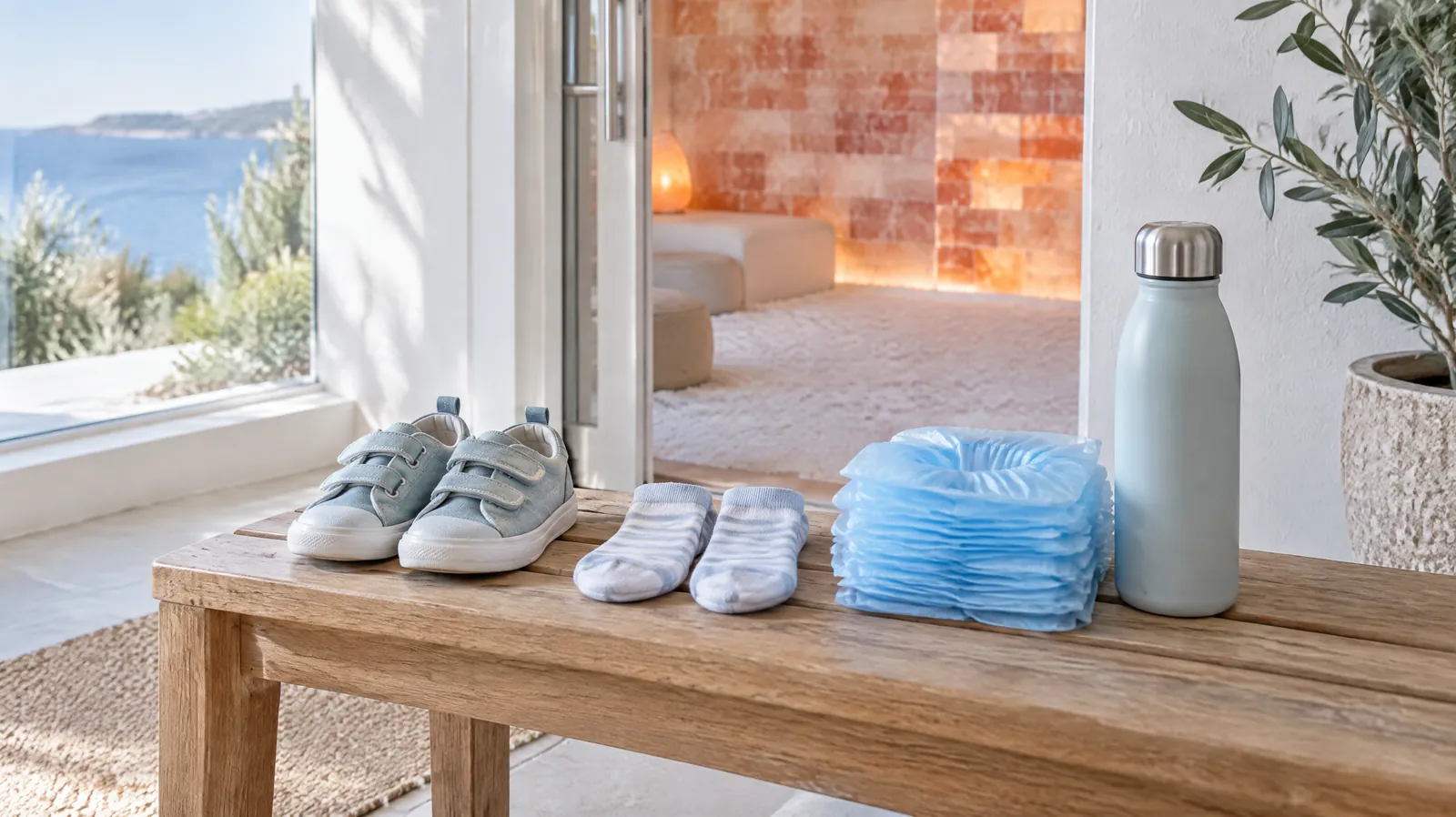
- Hands and clothes. Comfortable clothes they can get dusty, socks or shoe covers as the studio asks, and a hand wash on the way out.
- Water. Bring a bottle for after the session; salty air leaves some people thirsty.
- The reliever inhaler. If your child has one, it comes into the room with you. Every time.
- Hygiene. The ALA points out that warm rooms can encourage bacteria if they are not kept clean. A good studio will tell you how often the salt is changed or cleaned and how the room is ventilated between sessions.
Our salt room etiquette page covers the house rules we ask every guest, young or old, to follow.
Salt rooms, saline sprays and a day at the beach
Parents often lump these together, and it helps to pull them apart.
Saline sprays and rinses are liquid salt water delivered straight into the nose. Cleveland Clinic notes that saline solutions for sinus care have evidence behind them, which is why pediatricians often suggest them for stuffy noses. If congestion is the main problem, that is the first conversation to have with your child’s doctor, and it costs a few dollars.
A salt room puts dry salt particles in the air of a closed room. It is a different thing, with far less research behind it, as described above. Some children love it as an experience; that is a perfectly good reason to go, as long as nobody is expecting it to do the job of a medicine.
A day by the sea gets the same nostalgic credit. Fresh air, movement and time outdoors are good for children in plenty of ways, but sea air is not a measured dose of anything, and a windy beach in pollen season can bother an allergic child as easily as it helps.
None of these replaces what actually controls childhood asthma: the medicines and the action plan your pediatrician sets up, and keeping known triggers out of the home.
Questions to ask any studio before you book
Whichever studio you choose, these questions will tell you a lot in a few minutes:
- Is it an active room with a halogenerator, or a passive salt-décor room? The research was done in active rooms. Passive rooms are pleasant but put little salt in the air.
- What salt does the generator use, and how often is it serviced?
- How are the salt floor and toys cleaned, and how often is the salt replaced?
- How is the room ventilated between sessions?
- Do you run children-only or family sessions, and must a parent stay in the room? (The answer to the second part should be yes.)
- What do staff do if a child starts coughing or wheezing? Listen for a clear, calm answer, not a sales pitch.
- Do you make health claims about curing asthma or allergies? If they do, that tells you something about the studio.
Our honest view
We think a salt room can be a calm, happy hour for a lot of children: a sandbox that does not get anyone wet, low light, quiet, and a parent sitting close by. For a child with mild, well-controlled asthma whose pediatrician is comfortable with it, a short supervised session is a reasonable thing to try.
What we will not tell you is that it treats asthma. The best pediatric trial found less twitchy airways and better quality-of-life scores, with no change in lung function, in children with mild asthma. That is a hint worth taking seriously in future research, not a reason to change your child’s care. Keep the inhalers, keep the action plan, and treat the salt room as one more pleasant, low-key way to spend an afternoon.
If you want the wider picture for adults too, we went through the asthma, COPD and sinus studies in What the Research Actually Says About Salt Rooms, and our halotherapy page explains how our own room works.
Sources
- Halotherapy as asthma treatment in children: a randomized, controlled, prospective pilot study (Bar-Yoseph et al., Pediatric Pulmonology, 2017) pubmed.ncbi.nlm.nih.gov
- Effect of Halotherapy in Children With Asthma — ClinicalTrials.gov NCT06250452 clinicaltrials.gov
- Speleotherapy for asthma — Cochrane Database of Systematic Reviews (Beamon et al.) pubmed.ncbi.nlm.nih.gov
- Most Recent National Asthma Data — U.S. Centers for Disease Control and Prevention cdc.gov
- What is an Asthma Action Plan? — HealthyChildren.org, American Academy of Pediatrics healthychildren.org
- Promising or Placebo? Halo Salt Therapy — American Lung Association lung.org
- What Is Salt Therapy? — Cleveland Clinic health.clevelandclinic.org
- Halotherapy: An Ancient Natural Ally in the Management of Asthma, a comprehensive review (Crisan-Dabija et al., Healthcare, 2021) pmc.ncbi.nlm.nih.gov
This entry is for informational purposes only and is not medical advice. Salt therapy is a comfort practice, not a treatment — consult a qualified healthcare professional about your specific situation.